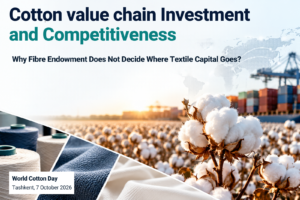

Why Fibre Endowment Does Not Decide Where Textile Capital Goes
The global textile map carries a structural contradiction: the countries that grow the fibre are rarely the ones that convert it into export earnings. Shares of global cotton production set against shares of global apparel exports make the split visible:
- India: 20% of cotton production, 3% of apparel exports
- Brazil: 15% and 0.04%
- Uzbekistan: 3% and 0.2%
- C-4 Africa: 2% and under 0.01%
- Bangladesh: 0.10% and 7.2%
- Vietnam: under 0.01% and 7.4%
Fibre proximity is a third-order variable in a textile investment decision, and in landlocked geographies logistics costs offset it entirely.
A Flat Fibre Market Changes the Underwriting Logic
Global fibre consumption rose from 90.6 million tonnes in 2015 to 116.5 million tonnes in 2025, a CAGR of 2.6%. Cotton sat out that expansion, moving from 24.4 to 24.6 million tonnes with weather and price cycles driving the swings in between. Polyester accounted for roughly 77% of the volume added, while cotton’s share of the fibre mix fell by about 6 percentage points.
No textile investment can be underwritten on fibre demand growth. New capacity must win share on cost and supply reliability, which is why investors test five considerations: cost, market access and its durability, logistics, buyer compliance, and the ability to repatriate profits and exit.
Scored on that lens, India emerges as a converter at scale, and Uzbekistan as a low-cost producer held back by logistics. Brazil pairs a strong fibre base with costly conversion, while C-4 Africa ships lint out and imports garments. Bangladesh operates as a low-cost converter with no fibre base, and Vietnam turns imported fibre into exported value.
Six Enablers That Outweigh Subsidies
Capital follows predictability more than incentives. The enablers that shift project economics:
- A credible ten-year tariff and tax regime
- Plug-and-play land, power, effluent treatment and testing
- Skilling at worker, supervisor and manager level, where most failed projects fail
- Duty-free access to imported trims and accessories
- Single-window approvals, since a 12 to 18 month delay erodes IRR more than any tariff differential
- Ecosystem depth in fabric, trims and testing that shortens lead times
For cotton economies such as Uzbekistan, the conversion gap is engineered, not inherited. It closes through legislated policy, shared infrastructure funded by development finance institutions, and brands willing to pay for the traceability they demand.
The full report benchmarks six cotton and apparel economies across cost, access, logistics, compliance and exit. Download it to see where fibre endowment converts into investment readiness and where it does not.